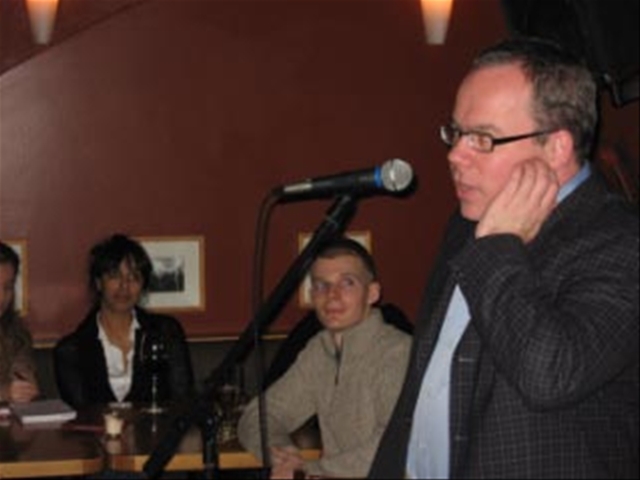
 Blogger and columnist Paul Wells brought out the largest Third Monday social media meetup crowd yet.
Paul started out quoting from a recent newspaper article that suggested that citizens have become convinced that politicians and journalists are talking primarily to one another – not to citizens. A really ornery political context. Journalists receiving nasty emails. Blogs that pounce on even the most innocent mistakes of reporters. And that describes the experience in … France.
Sounds familiar. But in fact, the French political system and situation is very different from the North American systems. However, the one thing that we have in common is the Internet.
 As the new tools of social media have come online, power has been leaking away from the traditional power centres, the politicians and the media and moving to the citizenry – a radical democratization of the discourse that is essentially irresistable.
Two Canadian messengers. Two very different situations:
Robert Libman spoke out in the late 70s against language legislation that the English minority in Quebec saw as threatening to its existence. As a 28 year old, he founded the Equality Party. His party elected four members of the Quebec National Assembly. As a Party Leader, Libman challenged Quebec’s referendum law before the courts. He eventually won his case – five years after the referendum. At great cost and to no immediate effect.
Brayden Cayley is an undergraduate student at the University of British Columbia in Vancouver. He was a delegate for Gerard Kennedy at the Liberal Leadership convention last December 2006. Cayley became concerned that the Liberals were going to open up the Constitutional debate again. He prepared a video that he posted on YouTube and sent an email notice of it to all the delegates at the convention. Within a week, a thousand of the four thousand delegates to that convention had seen it.
 Look at the difference that a decade makes. Suddenly, the incremental cost of getting in on the great debates of the day is zero. You need a computer, an internet connection – and you can have an impact. And you don’t need to ask anyone.
As power democratizes, it makes it harder to trace, harder to define and harder to control.
The new power is diffused. It can be spread through thousands. And therefore, it can is likely to be less effective than other newer strains of new media.
Blogging’s Canadian political coming out was intended to be the 2006 Liberal Leadership convention. Bloggers marginalized themselves by hanging out in the blogger lounge, failing to mix on the convention floor. The truly engaged Liberal bloggers posted rarely as they were too busy talking to and twisting the arms of the other delegates. The few who did post regularly produced posts of little value and insight.
Sadly, Canadians do not have a lot of political bloggers with the depth of some of the leading American political bloggers. The fruitsandvotes.com political blog has a Canadian section that shows more insight and authority than the Canadian political blogs.
 Canadian political bloggers need to get serious, quit their day jobs and begin to dig deeper.
Other new media, such as YouTube have greater potential than blogs for the best content to emerge. The most-accessed, most compelling rises quickly to the top.
Wikis. In the day of Wikis, governments can conduct a consultation online without the need to travel thousands of miles or ask people to leave their homes. It’s utterly cost-free. They can afford to experiment, afford to fail in this – without gouging the tax payer. And that’s worth looking at in this age of increased accountability.
The central assumption of social media is that a thousand people are smarter than any one person is.
 Why is opening up and trying this worth doing? Paul cites the example of Estonia. During the Soviet era, if the government knew more about you than you knew about the government, it could be fatal. When the Soviet Union dissolved, the new government invested heavily in technology, the Internet and wireless technology. They used this to give the public unprecedented access to information the government holds about them and also to the people who are accessing this information. Cabinet meetings are essentially live-blogged. The decisions are public decisions, with decisions taken announced to the public within minutes of being made. People now know what their government knows about them and they know what there government is doing.
I f this can be done in Estonia, it can be done elsewhere. Like here. In Canada.
Which brings us to Stephen Harper. He understands the importance of channeling information through the new media around the traditional media. That’s why Harper was posting audio and video of his speeches on his Website shortly after being elected. Why he has his own channel on YouTube. Why political blogger Stephen Taylor has a better channel into the PMO than virtually any reporter in Ottawa.
 So, what of the next campaign? Wells predicts that the Conservatives will run a very traditional central campaign. Having reporters filing on deadline as they always have. But while they are doing this, the Conservatives will be setting up the next day’s targeted communication – and communicating it using social media. Blogs, videos on YouTube, viral emails.
And what’s the value of the very expensive campaign plane flying across the country loaded with Canada’s top journalists? It’s a great way to cage them up.
Coda: In a question about the relevance of Paul’s Inkless Wells blog to his employers at Rogers and Maclean’s Magazine: The further you go upstream, the more interested the executives are in new media. Roughly speaking, the parts of Rogers business that Orson Wells might recognize – the traditional print properties might generate $1 of profit. The core cable business – the business that Harvey Kirk might recognize probably generates $2 in profit. The new electronic businesses, especially the wireless business, that didn’t exist 15 years ago, generate $4 in profits. And that drives the interest of the most senior executives.
“I started the blog as a hobby and now it may save my career. ;-)”
Thus said Paul Wells.

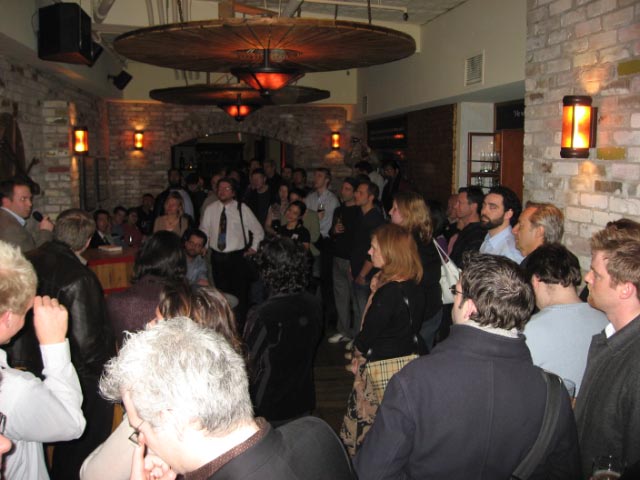
 So, if you were at Third Tuesday and post about it, please let me know by a comment or TrackBack to this post.











 “While the old Web was about Web sites, clicks and “eyeballs,” the new Web is about the communities, participation and peering.”
 We have a great speaker – Mark Evans – to kick off Third Tuesday’s 2007 spring season.
 The New Year is a fitting time to take the wraps off two new members of our social media community,