What do you think of our "Social Media Websites?"

76designMy colleagues at 76design have launched their new Website. I think it rocks! And I hope you like it as well.

The 76design site is a companion to the Thornley Fallis site. Both sites are built around the blog and podcast content of the employees who work at the companies. This “social media design” enables visitors to learn about the companies through the blog postings of the people who work here. People like Michael O’Connor Clarke, Chris Clarke, Terry Fallis, the PR Girlz, the 76design team and me.

Thornley FallisWe designed our Websites this way because we understand that companies are in essence the people who work for them. And we want visitors to come to know us through the eyes of our people. If we are successful in creating an environment that attracts and supports creative, thoughtful people who are passionate about their work, this will show through. And we will be successful.

At least that’s our belief. And as time passes, we’ll test this belief through experience.

Please let me know what you think of our sites. Do you like the approach? Does it work? How can it be improved?

Can you see the future of blogging?

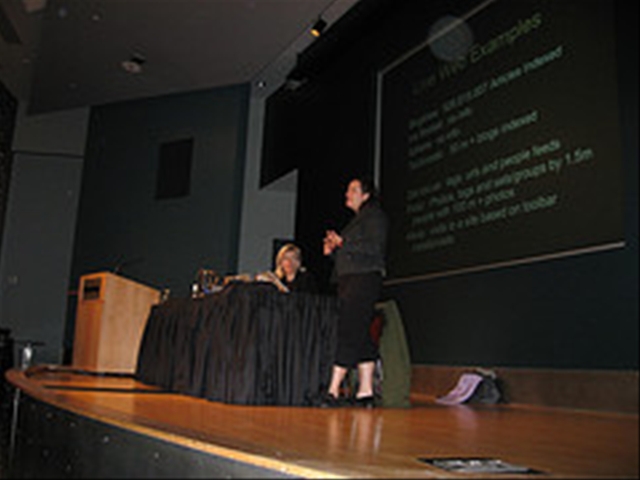
Matt Mullenweg and Liz Lawley closed out the Blog Business Summit with a look ahead to The Future of Blogging: Tools and Trends.

Liz Lawley:

Transparent functionality will be built into all tools. The easy integration of photos, videos, books, audio and collections that is offered in Vox, launched yesterday by SixApart, represents the new standard.

Liz also looks for a trend to Low Overhead Blogging: tools that enable you to easily add information into your blog.  An early example of this type of tool is ShoZu, which enables you to easily move videos, photos and music while you are on the go.

The idea of Global Input will be hugely important. The ability to input from a mobile device. She points to Microsoft Aura! as the type of tool that will support this.

Selective Sharing will become an essential function. Sharing based on user defined groups. This also relates to Selective Publishing. As more people blog, they will demand a tool that enables them to selectively publish to one or another of their blogs.

Socially Filtered Search, the ability for me to filter my search results through my social network. When I am searching, I care more about what the opinion leaders in my space or my network think that I care about the universe as a whole. We need tools that let us build our own network for this purpose. And early entry into this space is the “Add me to your network” badge on del.icio.us.

Matt Mullenweg:

Blogging technology was developed ten years ago. What is different today is that there is a mass audience that is using and reading them.

It’s not about the technology. It’s about the audience. And with the larger audience, we are increasing the opportunities to publish.

Before, the publishing Internet was restricted to 1%. Now, more people are able to join in.

And this expanding audience and subset of authors will shape the future.

Discussion:

Liz Lawley: I predict that within five years the word blog will become as irrelevant as the word homepage has become. This will simply be a part of what we do.

Dave Taylor: The future of the web is conversation and social networking. This will not be tied to any single tool.

Matt Mullenweg: If we are successful, in five years you won’t know what WordPress. It’s elements will be incorporated in all platforms and their operation will be invisible to the user.

And the final word on design goes to ZeFrank.

Blogs, search and the Changing Media Landscape

John Battelle delivered the Friday afternoon keynote address on Blogs, Search and the Changing Media Landscape.

“Why am I standing in front of you? I went to Berkeley ;-)” The story: Wired. Hotwired. Industry Standard. The Standard. The 4th. quarter of 2000 – out of a job. Back to Berkeley. The SearchSearchblog. Web 2.0 Conference. Federated Media Publishing.

The Internaet Economy is the third wave of tech and culture.

  • First wave: Digitize the Back Office. The C:_ command prompt. Only a few people touched the technology.
  • Second Wave: Digitize the front office. The PC. A lot more people touched technology and a lot more money came into it.
  • Third Wave: Digitize Customers. Google. Touches everyone.

Search is still in its infancy. We use the command prompt/search bar. But the big difference is that we can enter plain language. And that’s a big thing.

Web 2.0 principles:

  • The web is a platform
  • The architecture of participation: Companies understand that it is smart to let their customers help them make their business better. The web can be a platform to make that happen.
  • Lightweight business models: Many companies were developing new things, but they weren’t trying to do it all by themselves. For example, up until recently, Google News had only 17 employees.
  • The Long Tail: These companies were harvesting new value that was being created by the Web.

Search rules.

  • Search drives Web 2.0 businesses.
  • Our culture’s point of inquiry, the spade with which we turn the web’s soil, artifact of a new culture. Our search histories can be saved and mined and handed down.
  • A new reality for all forms of tradition business. Paid search is the first true leveraging of the database of intentions.

When it comes to marketing, search has provided an entirely new catchment point for marketing. We declare our intent in the search box. Then search organizes the data and presents it to us. In the old media days, we would buy commercial space on programs/media drawing a demographic. Now, with search we can buy keywords – expressions of intent. Intent drives content.

Search drives content to social media sites … where consumers expect all participatns to understand the mores of those environments. And they expect businesses to know what they want.

Marketing becomes a dialogue, not a dictation of one to another.

Traditional media and marketing is ruled by distribution: if you get that, you get attention. Now, attention is not controlled by distributors, it’s controlled by the consumer. There are now new centers of attention: search and social media platforms.

Content is once again king, and the landing page is queen. All businesses must join the Point-to Economy (links = votes = attention).

The promise of the web is the ability to know who you customers are and what they want and then draw them into converation. This requires business to think differently about retrn on investment. Marketing is about more than satisfying demand. It’s also about creating it. And how do you measure that?

New advertising campaigns must recognize all of these factors and break out of the old mindset (no more dinosaurs, Microsoft!)

Podcasting and Video Blogging Best Practices

An all star panel – Robert Scoble, Andru Edwards and Mary Hodder – promised to reveal Podcasting and Video Blogging Best Practices.

Robert Scoble: Start out by knowing the story that you want to tell. And edit it to tell the story from a distinctive perspective.

Expectations of production quality are going up. Rocketboom is using a $1,500 HD camera. While not everyone uses this quality of equipment, people expect better quality sound and images that don’t shake.

If you are using a cheap, on camera microphone, stay close to the subject to eliminate the ambient background noise.  A wireless microphone is a worthwhile investment.

Mary Hodder: People will engage more with quality video. So, if you want to reach your audience, it is important to improve the technical quality of the video you post.

Robert Scoble: It’s still early days for video on the web. So, you can experiment.

Andru: Edwards: You can even use a still camera to capture short web quality videos.

Mary Hodder: Freevlog offers good resources for people interested in video blogging.

Robert: It’s a fun community right now. Because people are experimenting and trying things out.

Video bloggers can obtain sponsorship revenues by hosting their video blogs on revver.

For casual video bloggers, Robert suggests they look at bliptv, YouTube, google video or similar services. However, when uploading video to a service like YouTube, read the EULA (licence agreement) closely. You may be giving up the rights to your content.

Libsyn is another affordable solution for hosting podcasts and videos.

Mary’s company, dabble, is a search and sharing site for video. (Robert asked, so it was OK for Mary to talk about it.)

BBS: Maryam Scoble and that guy she brought with her…

Maryam Scoble and some guy she brought with her presented Ten Ways to a Killer Blog. And they should know.

Maryam: Don’t start blogging when people tell you to do it. Do it only when you feel like it.
Robert: How do you start a blog? Start by reading other blogs. By doing this, you’ll be able to identify styles of writing that you like. And you’ll also figure out whether you will be a good blogger. Because if you read blogs for a few weeks and find that you are not constantly commenting on other blogs, blogging may not be right for you. Blogging is about conversation and if you don’t comment regularly, you’ll probably write a “press release” style blog – and they’re really boring.

Maryam: When you start to blog, you’ll develop friends and online relationships. You’ll learn and you’ll develop a network that will be valuable.

Robert: If you’re trying to build a business audience, become an authority on it. And be generous by sharing your knowledge. And link to others. This will draw people to you.

Maryam: There are two kinds of bloggers: Bloggers who want to make things, shake things and change the world. There are other bloggers who just want to talk to their friends, post their baby pictures, talk about books, and share with friends. But regardless of which type of blogger you are, there are some things you must know to make your blog popular.

Robert: It’s a google world. The first thing most people do when they are using the internet is to go to the search bar. The search bar has become the primary entry point for using the computer.

People who focus their blogs on a single niche seem to do better than people who write generalist blogs. If you understand this, you must pick a niche you can specialize in and develop a unique perspective. This will allow people to find you and to return to you.

Can people still do this or have all the niches been occupied by early bloggers? Mike Arrington and TechCrunch is an example of a late entrant who developed a distinct voice by picking a narrow niche and going even deeper.
Link to other blogs.

When Robert began to blog at Microsoft,  he began to link out. And as he did, people noticed and began to interact with him. As they did this, their comments moderated in tone.

Maryam: Even A listers maintain searches for their name. If you write about them, don’t be surprised if they comment on your blog.

Robert: Anyone can become an A lister with great content. For example, by having an interview with Steve Jobs.

He was challenged on this by voices from the audience. But Maryam came to the rescue.

Maryam: “I think it’s about coming up with consistent stuff. By covering interesting things and saying interesting things on a regular basis. It takes time.”

Robert: “There’s not just one A list. There’s 100,000 A lists. There’s one for every topic.”

Maryam: “There’s no one right way. I write about many different topics. My way is different from Robert’s.”

Admit your mistakes.

Maryam: “This is one of the reasons I didn’t want to blog. I read Robert’s blog and many of the comments were very harsh personal attacks. Because of Robert’s response, he gained credibility.”

Robert: “This is something I’ve learned. Richard Nixon didn’t admit that he’d made a mistake and people just kept piling on. When I make a mistake I try to admit that I’ve done it.”

Write good headlines.

Robert: In a google world, keywords and good headings count. In a world with much greater volume, you have to scan more rather than read deep. So, write good, descriptive headlines. They will stick out of the list. And they’ll be found more easily.

Robert showed the homepage of techmeme to illustrate that someone who writes good headlines will get noticed.

Use other media.

 Robert: TechCrunch is a good example of this. When Michael Arrington started, every post had a graphic. This raised the bar. And today, you need to use a variety of other media – pictures and videos in particular.

Even if you are a text blogger, you can use a visual to stand out. This is why many text bloggers use lists. By breaking a text blog into a list, you can grab attention.

Robert pointed to crayon as an example of a company that is using Second Life to stand out. And GM uses flickr pictures.

Have a voice.

Maryam: Let people see you behind the posts. It will make people want to connect to you.

Get outside the blogosphere.

Maryam: By going to conferences, meeting other people, you will develop stronger relationships. And this still counts with blogging.

Robert: This is where the PR people miss out. They don’t realize that they need to go to conferences and meet people.

Market yourself.

Maryam: Recently, my blog was featured on the Best of MSN. I got 4,000 hits per day as a result of this.

Robert: Put your URL on your business card. It will help people to find you. Also, be creative with your business card. It’s those little touches that will help you.

Search google for Scoble business card tips.

Write well.

Maryam: Before you publish your post, do a spellcheck. Reread to be sure you said what you wanted to say. “Check your state of mind and state of heart” to avoid saying things you will regret.

Robert: Write short paragraphs. Put the most interesting information up top (the journalistic inverted pyramid.)

Expose yourself.

Robert: A lot of corporate types are very reserved about their writing. Every blogger has a knob that reads “safe” on one side and “interesting” on the other side. Don’t stay on the safe side. Spice up your blogs by showing something about yourself. Tell stories. Move the needle to the interesting side and you’ll get a more engaged side.

Help other people blog.

Maryam: Share what you’ve learned and help other people get into the community. That will build the network globally and for yourself as well.

Engage with commenters.

Robert: A lot of corporate ty
pes are skittish about going to other blogs and participating in the conversation. Simply having your own blog is not enough. You need to go to other blogs and comment to become known and to attract new readers to your own blog.

Keep your integrity.

Robert: “Dave Winer would keep telling me this.” You are what you appear to be. Don’t try to fool people or misrepresent yourself.

Thanks to Maryam Scoble and Robert Scoble for an enjoyable, engaging session by two people who really project happiness.


BBS: Ben Edwards

 The session topic: Branding in the Age of YouTube. The speaker, Ben Edwards, Director of New Media Communications at IBM’s headquarters in Armonk, New York and one of the key players in developing IBM’s social media strategy.

Ben Edwards began his presentation by announcing that he is an imposter – a print journalist (14 years in print journalism, nine years at the Economist). Both he and IBM are relatively new to publishing.

What is IBM New Media Communications?

It’s really all about skills, developing enterprise applications for social media from internal communications to media relations and marketing. Ben is focused on the enterprise. This is different from the set of challenges and questions encountered when deploying social media outside of the enterprise. There are IT requirements that make it more complicated. But on the other hand, once these are satisfied, deployment is much simpler as the software is known, trusted and standardized.

Ben believes that there is tremendous opportunity for enterprises to “destroy costs” by adopting social media. And innovation can be encouraged in this process.

Finally, Ben hopes to estabish IBM as a trusted resource for corporations adopting social media.

Blogging is being rapadly embraced inside of IBM. At this time, they have about 3,400 active blogs. Of course, it’s very time intensive. And there is also a bit of an echo chamber with bloggers talking about other bloggers. Ben hopes to counteract the echo chamber by bringing even more bloggers online.

They have a podcasting pilot that has grown to 180,000 monthly downloads in less than 12 months in existence.

Since the beginning of the year, Wiki use has skyrocketed. There are now more than 70,000 users of Wikis within IBM. Ben himself uses four different Wikis.

The rise of social media heralds the advent of a new commuications paradigm. Social media represents a new way of communicating that will become the dominant way of communicating.

Social media are not about the technology.

Social media should not be thought of as new “channels” for distributing existing content and messages. That’s a very impoverished way of thinking about these technologies. They are fundamentally different with different economics, different expectations and different conventions.

The new communications paradigm:

  • Publisher: In mass media, we had professional publishing. In social media, we have self-publishing.
  • Economics: For mass media, costs were high. Social media costs are low.
  • Audience: Mass media pursued a mass audiecne. Social media appeals to niche audiences.
  • Engagement: Mass media was passive. Social media calls for active involvement of readers.
  • Voice: Mass media gave voice to institutions. Social media gives voice to the individual.
  • Communications: Traditional mass media institutionalized publishers as power centres. Social media enables everyone to publish.
  • Marketing: Mass media relied upon advertising. Social media attracts readers on the value of the publishing – the quality of the ideas.

Now, about branding….

Brands began life in consumer products as a symbol of quality (think Campbell Soup). By the 1960s and 1970s, brands began morphing into symbols of consumer identity (think VW Beatle, Marlborough Man). By the late 1960s, many brands were marketed on emotional attributes.

More recently, brands have become symbols of our social aspirations (BP – beyond petroleum; GE – ecomagination; IBM – innovation that matters.)

The prevailing orthodoxy of social media is that they will transfer control of the brand from the corporation to the consumer (Steve Rubel.)

Ben Edwards argues that corporations lost control of their brands the moment they became symbols of emotions and aspirations. There is a lot of volatility in brands. We punish them mervilessly. We fall quickly into and out of love with brands. When they no longer do things for us, wear the clothes we want, project the image we want, we punish them.

Since 2000, brand disasters include Gap, Sony, Kodak and Ford, each losing between 30% (Gap) and 70% (Ford) of their brand value.

As brands engage with social issues, brand insecurity may be worsening. Look at Merck or bp. Each is seeing their brand value destroyed by controversies around business practices and ethics – things that do not related directly to the quality of the product.

What has changed between us and them?

  • They can create and share the brand themselves.

In the mass media world, the brand image was shaped through mass media and advertising. In the social media world, audiences of all kinds discover communities of interest and publish the brand to each other.

Look at brands on YouTube. People mash them up. They mock them. They celebrate them. They make the brands perform strange and unnatural acts (Coke and Mentos.)

And it’s not just happening on YouTube. It’s happening all over the Web. Technorati. myspace. orkut. flickr. circuitcity (customer reviews on its site).

  • We can listen better.

With mass media, corporations would push out their messages and feedback would be throttled through mass media gatekeepers. With social media, there are an unlimited number of consumer feedback points.

  • We can create and share the brand with them.

With mass media, corporations attempted to dictate brand image through massive advertising. With social media, corporations may influence brand by inviting the audience to create and share the brand with them. Ford’s bold moves campaign is an attempt to do this.

Brands are at their strongest and healthiest when they speak about us and the people behind us. Social media allow us to open ourselves to the world.

Finally, Ben laid our an agenda for change:

  1. Don’t try to segment your audience. Nurture a brand which employees, customers and all constituencies can relate to, emotionally and intellectually.
  2. Provide emploees with the measn to tell their own stories about the brand and in their own words. (Look at the difference between Southwest Airline and JetBlue.)
  3. Listen. Listen to what employees are saying about the brand. Listen to what customers, partners, suppliers and shareholders are saying about the brand.
  4. See the first bullet.
  5. Where there is potential for a positive outcome, engage to influence.

Blog Business Summit – Friday sessions

One day down and another full – really full – day to go.

This morning, I plan to take in:

That’s a lot. (Deep breath) And in the afternoon:

I’ll post after each session. Stay with me!

BBS: Mary Hodder, Dave Taylor and Halley Suitt

 RSS and Feeds: Monitoring the Blogosphere and the Buzz with Dave Taylor, Mary Hodder and Halley Suitt.

Dave Taylor led off. He posed the question, “How do you find bloggers who are writing about your space?” You have a choice of tools, including: google blogsearch and technorati.

Technorati ranks bloggers by authority – the greater number of inbound links from other blogs that they receive, the higher their authority.

With Technorati, it is possible to “subscribe” to a search. This will deliver new entries relating to the search term directly to your browser as they are posted.

An RSS aggregator such as newsgator online, bloglines or google reader is an absolutely essential tool to keep up with your RSS feeds.

Mary Hodder spoke about the difference between how Google searches and show results and the way that a blog-specific search enigne like technorati searches and displays results.

Google is best at measuring the “static web;” technorati is best for the “live web.”

Google is best for static web pages – pages that do not change regularly. Bloggers change their content frequently and a search engine is required that specializes in current information which may not show up immediately on the google search engine.

It is also possible to track images uploaded on flickr by tags.

Other possible metrics include the number of comments (some bloggers may not have many inbound links, but may have many comments. ) If you only take inbound links without looking at comments, you may fail to see the real depth of the conversation at the site.

Frequency of blogging on a topic is another dimension to consider. A blogger who writes frequently on a particular topic may not have the same authority on another subject that they blog on only once or twice.

Mary sees a difference between influence and real authority. Authority happens on a person by person basis. Each of us assigns authority. However, technorati will rank people high in “authority” – which really means they are high in popularity.

Halley Suitt showed several examples of Web sites that display RSS feeds differently. Some display them with XML chiclets. Some use the new RSS standard icon. Others have text links to the RSS feeds. For RSS to become mainstream, RSS must be displayed in a more standardized and prominent way.

BBS: Halley Suitt, Janet Johnson, and Buzz Bruggeman

The next session was a panel with Halley Suitt, Janet Johnson, and Buzz Bruggeman.This session was billed as: Engaging with Bloggers: Working the Blogosphere. It promised to provide insight into the right way to approach blogger relations.

Halley Suitt: “For starters, can you please know what I’m writing about? Read my blog. … Everybody should take a month and read the blogs you are interested in and read them before you approach them. … Even within similar blogs, there are different perspectives and interests.”

Janet Johnson: “I was the person in the other seat two years ago when Jason started to rant against people paying bloggers, when Marqui did it. … It’s really important to have people in the blogosphere know what you want from them. If I’m a blogger and you want me to write about you, be very honest about what you want. Bloggers want to help others. But they need to know what you are up to.”

Question: What do you need to do to prepare?

Halley Suitt: “You need and aggregator and you need to subscribe to RSS feeds.”

Janet Johnson: “I also go out on the blog search engines and type in keywords and names. And then I find the feeds that are talking about the subjects that I am interested in.”

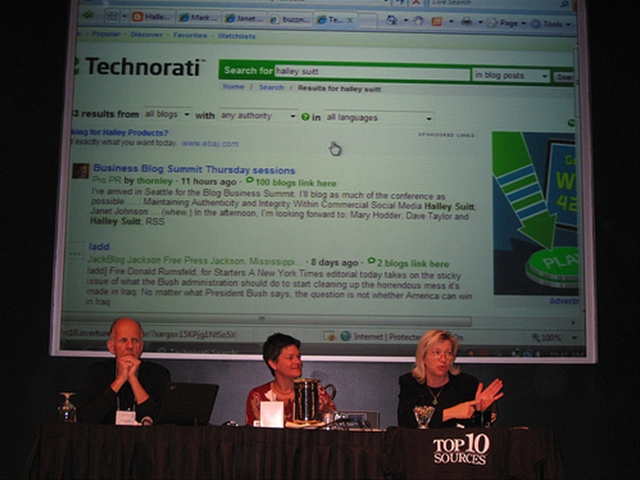
Imagine my surprise when Buzz Breggeman decided to show the audience how technorati search feeds work and what comes up at the top of the search for Halley Suitt? My ProPR post!

Buzz Breggeman: If you are a PR company that wants to pitch a company to help them, try their product BEFORE you call them.

Halley Suitt: If you are pitching me, include lots of data and all the necessary background.

Halley Suitt said that she had engaged a public relations agency for her company. And she was impressed that the PR people talked to her about a post on her blog. “They had read it. They showed they cared.”

Buzz Breggeman: “You don’t get points for shyness. You don’t get points for staying away from interesting topics. In my own blog, I only write once about every six or seven posts about my company. But most of my posts are about customers. What they need. What they are saying.”

“How do you engage a blogger? Read the comments. You’ll find whose interested in what topics. Most of the conversation goes on in the comments, not on the main posts.”

BBS: Jason Calacanis

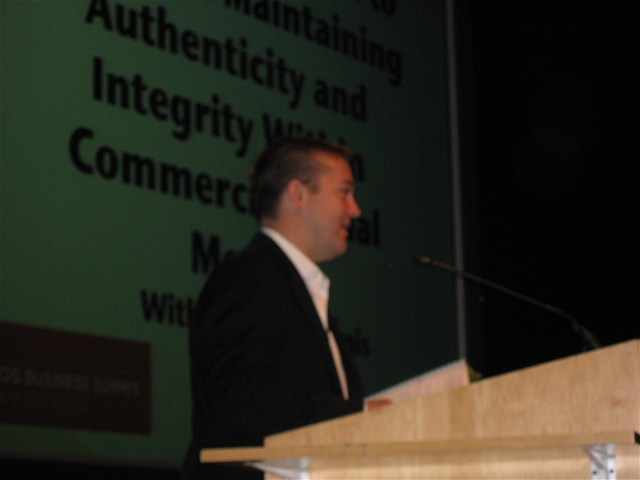
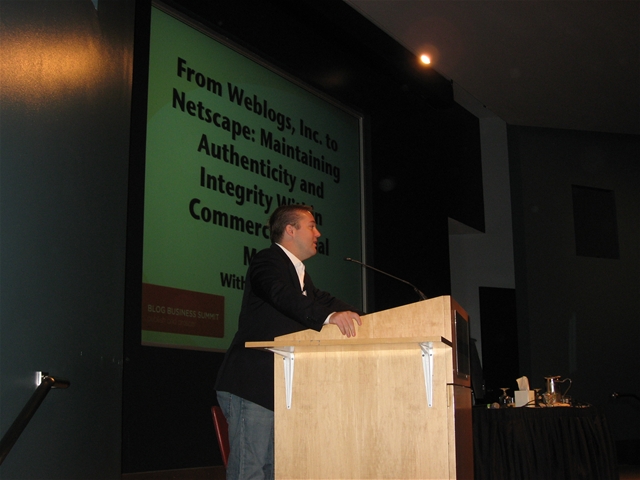
Jason Calacanis’ keynote was themed: From Weblogs, Inc. to Netscape: Maintaining Authenticity and Integrity Within Commercial Social Media.

Integrity. I was looking forward to this presentation after the aggressive stance Jason took earlier in the week in response to Newsgator’s experimentation with advertising on Newsgator Online.

“Good morning. My name is Jason and I’m a blogger.”

There are all types of uses for a blog today – to express a personal view, to build a business or to generate revenue. A blog is like paper. You can make a book, a beautiful magazine or toilet paper.

(Justin Hall began the first blog in 1995. If you don’t know who Justin Hall is, find the movie, HomePage, and learn about the roots of blogging.)

“The thing that attracted me to blogs was authenticity. They are very real.”

The year 2003 was the year when blogs really broke through. That was a dark time full of mistrust of mainstream media (Fox News!) Blogging software already existed. And when a large number of tech people were laid off, the perfect conditions were created for blogging to break out – motivation, tools and people.

 In 2003, Jason was publishing an online magazine. And as he watched his writers go out and be successful with the then emerging blog outlets. And as he watched his traditional publishing business wind down, he realized that he needed to change. Out of this, Weblogs was born. At a time when the business model was not proven and when there was suspicion about trying to commercialize blogs.

Jason regaled the room with anecdotes of his seminal moments with other web and blogging personalities – some happy (Peter Rojas, Mark Cuban) and some unhappy (Nick Denton).

“We’re all outsiders. Bloggers have found their own space, they’ve made it the way they want it, and they don’t like when you screw with it.”

His deal with Time Warner was found on an understanding that Time Warner would never try to mess with the Weblogs content.

“The forces of evil: Whenever something great is made, the marketers come in. There are good marketers and there are bad marketers. There are good people in life and there are bad people. …. There are some bloggers who are great. And there are some people who suck at it.”

“Want to be an A-list blogger. Go to Techmeme. Look for the top three stories. Write about them every day. Go to the blogs of the other people who are writing about these stories and comment. Do this every day and attend every conference going. And you’ll be an A-lister. Write once every two weeks and wonder why you aren’t an A-lister?

 “Blogging is the biggest meritocracy in the world. It’s not broken. You don’t rank? It’s because you suck. … How well you do is up to you.”

“It really is obnoxious to look at the space and say it’s broken because you’re not doing well. If you want to succeed, do a better job.”

“Then we have people who come along – like Payperpost. Now we get into the evil part of me. … I care when somebody comes into this beautiful place where trust and authenticity matters. And then these people come in and … they get into trickery…. If you go selling your posts and not disclosing it, that’s not innovative, that’s lying.”

At Weblogs, “we maintain a church and state separation of advertising and bloggers. The bloggers know about the ads when they see them on the site.”

“I’ve been talking about the payperpost folks. And I want to go over some of the arguments. … One of the things we do best as bloggers is argue. … But it’s always with a smile that we debate…. But you can be intellectually dishonest when you debate.”

“One of the first arguments of the payperpost people is, “We’re just an enabler.” When you enable people to do something wrong, you are part of it.

“They make the other crazy argument that The A list bloggers are trying to keep the Z list bloggers down. There are no A list bloggers. Just people who’ve been at it longer.”

“Tim Draper, you put $3 million into a company doing covert marketing. What were you doing? … What were you thinking, Tim Draper?”

Final thing: “This podcasting thing is going to be big. Two years ago I said that I didn’t see it. I was wrong. … Probably 20% of what I write is wrong. But that’s OK, because we get there together.”

“Something’s going on. I listen to more radio than I ever have and I never turn on a radio. Something big is going on. … I want to podcast and I don’t need the pay cheque. I will be dong calacaniscast on podtech. Podtech and GoDaddy together have donated over $100,000 to sponsor 50 episodes together. And the money will be used to sponsor two girls to attend the Baycrest private school in New York City.”

Audience question: What about YouTube? “I was fabulously wrong about YouTube. … At the end of the day was there growth based on a ton of copyright violations? Duh. But at the end of the day, I’ll give them credit for threading the needle. … Unlike Napster, they cut deals with the content rights holders. …. I believe that YouTube will go down as the company that will be seen to have convinced content holders to put their content out there and then to figure out how to make money later.”

Audience question: Why did you sell Weblogs? “When to sell your company is a personal question that depends upon your shareholders and where they are in their lives. Our shareholders were offered a deal that would pay them for the next three years of their lives. They wanted it and they took the deal. … You have to look at these things on a personal basis and pick when you exit. … This was right for our shareholders.”

Audience question: How about if you are transparent that somebody has given you money for something? “Yes. Transparency counts. … But if you’re going to make a media business out of it, you never ever want anyone to be able to say that you benefited from the people you wrote about. … All you have as a blogger is your authenticity, your trust.
Fight, do not ever let anybody get inside the blog post.”

An entertaining sesson with lots of quality name dropping. Look for it on YouTube.