Shel Israel speaks to OCRI Zone5ive

Shel Israel was the featured speaker today at OCRI Zone5ive’s first session of the year for technology marketers.

PowerPoint has a lot to do with a traditional way of thinking. I talk at you. My slides establish that I am the authority.

That was then. This is now.

Effective communication involves conversation. And blogging enables conversation. One to one conversations that scale to one to many and many to many.

The conversation is fundamental to marketing. But it has become divorced from the marketing that has been happening for the last 50 years.

Marketing at its base was word of mouth. The local butcher. The local shoemaker. Talking to the local resident.

However, word of mouth was unable to scale with the development of mass production, mass media and ultimately, mass marketing.

Now, we are in a period in which audiences for mass media audiences are splintering and shrinking. And mass marketing is not as effective as it once was.

We are entering a time in which people can speak directly to one another about what they believe, what they like, about their passions. And others read and listen to this.

Smart companies are recognizing that their blogging employees can put a human face on the company and its products. And they can engage in conversations with people who care the most.

The Edelman Trust Barometer this year indicated that the most trusted source of information is “People like me.” Not the traditional institutions.

Sidenote: In a room full of marketers, only two people raised their hands when Shel asked whether anyone knows who Richard Edelman is. 

When you understand what people are thinking, then you can decide what the wise course of action may be. If you want to hear what people think, start a blog. They’ll tell you what they want and need.

Blogging allows the conversation of two people who know and trust one another to scale around the globe.

Good marketing will take the customer out from the edge of the company and bring them into the center. Blogging can achieve this.

Dell is coming to terms with the need for and the potential of blogging. They have moved from their position of unresponsiveness at the time that Jeff Jarvis proclaimed he was in “Dell Hell” to launch their own blog. And while that blog was widely criticized in its early stages, they have learned and responded. Dell has changed. They have become part of the conversation. And their perspective is being shared.

The adoption of blogging by corporations has been slow to develop. But as they become more familiar with its potential, the pace of adoption will accelerate.

HR is the first place that should blog. New recruits will judge a company by its bloggers. The company that wants to attract the MySpace generation will supply new employees with an employee blog at the same time that they receive their telephone, their computer and their security pass. And they won’t be told they have to blog. Nor will they be told what to blog. This will send a signal to them that their employee understands the evolving world and trusts them to behave responsibly.

Something very fundamental has changed. One way communications to two way communications. The traditional advertising vehicles are becoming more expensive at the same rate they are becoming less effective. As a new generation comes into the mainstream, they will expect marketing to be conversational.

Shel Israel has naked conversation with Ottawa communication executives

Shel Israel met in Ottawa today with a group of about 30 government and private sector communications executives. Most of the attendees’ organizations have taken only preliminary steps in social media or have yet to engage with it. All were intensely curious about its potential impact on their organizations.

Shel led off with a brief introduction of the basic theme of Naked Convesations: Think of people having a conversation across their back fence. Without guile. One to one. Making judgments about what to accept at face value and what to dig further into. Through social media, people can connect via the Internet as if they were talking across their virtual back fence. And people with shared interests are seeking one another out and building new communities that transcend the confines of geography.

He then fielded questions from the audience.

How essential is it for a company to have a blogging strategy when making an announcement? It’s clear that people today go to Google as their first source of information. I want to know about a subject? I go to google. And blogs have “google juice” – they rank high on the search engine listings. So the answer is that companies should plan to reach bloggers in order to present a complete picture for those who will look for information regarding what the company is announcing.

How do you know who to trust? By becoming part of the community. By engaging in the conversation on an ongoing basis, you will identify the voices of authority and establish a trusting relationship with them.

What are the downsides for companies and organizations that fail to engage with social media? One, the MySpace generation – now 60 million strong – will not be keen to work for companies or organizations that do not adopt the kind of online communications that they have grown up with.

How to overcome the reluctance of senior executives to engage in blogging? Start with the recognition that the genie is already out of the bottle. Blogging is established and here to stay. Understand that companies that don’t blog will be suspect, regarded as companies that are not transparent and open to scrutiny.

Corporate fears? What if somebody comes to my site and says something nasty? Well, they’ll say it somewhere. Better that they say it on your site, where they’re like to be more polite and where you’ll see it and be able to react.

Seepage of intellectual property? There have been few instances of this. And employees should be covered with nondisclosure and ethics agreements as part of their employment agreements.

Ghost writers? Ghost writing is hokey. Better that someone writes with grammar mistakes and poor spelling than to have something polished by another voice. Readers can see through ghost-written blogs. And they rate them poorly.

Re Scoble and putting a human face on Microsoft. This can be done by other organizations. Companies can humanize themselves by freeing employees to speak about their enthusiasms, about what they and others believe about the place they work.

There are many people who believe that just being honest about our imperfections builds our credibility on the statements that we make. The resistance to own up to our failings is one of those things that distances and alienates organizations from their employees, their communities and their customers.

Blogs should be spin free zones. Authenticity is built by telling, not by selling.

Successful blogs are full of authority and passion. Shel pointed out that he periodically “picks a fight” with people. He speaks out if someone is spinning or denying the evident truth. He cited Robert Scoble’s recent calling out of HP as another example of a blogger speaking to their passion.

How to approach lawyers objections? According to Shel, lawyers are in the business of counselling you on how to avoid risk. But businesses cannot achieve anything without some risk.

Ottawa tech marketing community to be treated to Naked Conversations

OCRI Zone5iveNext Tuesday, Shel Israel will kick off the OCRI Zone5ive season of meetups of Ottawa technology marketers.

Naked ConversationsShel is co-author with Robert Scoble of the definitive book on blogging, Naked Conversations.

So, if you are a technology marketer in Ottawa, click straight over to the OCRI site and register to attend Tuesday’s session with Shel Israel. It promises to be a great start to Zone5ive’s season.


Canadian Communicators joining Third Monday and Third Tuesday Social Media Meetups

Canadian communicators are keen to get together to discuss the potential of social media, if the early response to Third Monday and Third Tuesday is any indication. With two weeks to go before the inaugural gatherings, 25 communicators have signed up for the Ottawa group and 43 have joined the Toronto group. This makes the Toronto group the second largest public relations group on meetup.com.

Naked ConversationsOf course, having Shel Israel, co-author of Naked Conversations, as our first speaker is a great way to kick off these new meetups.

There’s still lots of time to join. So, if you’re a public relations practitioner in either the Toronto or Ottawa regions, join up and come on out to hear a great speaker and have an evening of discussion and camaraderie with others who share a curiosity about social media and its application to communications.

Toronto and Ottawa PR meetups to discuss social media

Public relations practitioners in Toronto and Ottawa have a new monthly forum to discuss social media from a PR perspective.

Ottawa meetup The Ottawa meetup is called Third Monday. The Toronto group is called Third Tuesday. And, you guessed it, they’ll generally be held on Mondays or Tuesdays.

A great group of bloggers and social media enthusiasts have come together to get these meetups going. Joining me in organizing the groups are David Jones, Terry Fallis, Ed Lee and Chris Clarke in Toronto and Colin McKay, Brendan Hodgson and Ian Ketcheson in Ottawa.

Toronto MeetupWe believe that public relations practitioners have a unique perspective on social media.  We look at social media as an extension of the conversations we have always had with journalists and stakeholders to now include a much larger group of citizen journalists and interested people whose online conversations lead to the formation of communities of interest.

Others groups have different starting points and different perspectives on social media. Advertisers, for example, start from the perspective of disaggregating mass media and the need to find new advertising vehicles and strategies that will replace failing mass media campaigns.

Because we have this unique perspective, public relations folks have different conversations than do those people who are grounded in other disciplines. First Monday and First Tuesday will provide us with the opportunity to talk about social media framed as a public relations challenge. We will be able to focus on its potential for and impact on our profession. How we can extend our capablities by embracing social media. How we can enhance our careers. How we can better serve our clients. And how we can then take our best thoughts forward into the broader discussion with others. Ensuring that public relations is well represented. Ensuring that public relations is in a leadership position in exploring and applying social media.

Shel IsraelWe have a great first speaker to launch our meetups. Shel Israel, co-author of Naked Conversations, will kick off the gatherings with back to back sessions on September 25 in Ottawa and September 26 in Toronto. I can’t think of a better way to kick off the discussion than with a man who hails from PR and who wrote THE book on blogging.

So, if you are a public relations practitioner who wants to meet other PR folks to talk about practical applications of social media, join the conversation. Sign up for Third Monday (Ottawa) or Third Tuesday (Toronto).

And, for those who’ve spotted a similarity to the SF Bay Area Third Thursday group organized by Mike Manuel, Jeremy Pepper, Giovanni Rodriguez, and Phil Gomes, you’re right. In looking for a model, we thought that Third Thursday was exactly what we wanted to replicate in Canada. Mike gave us the go ahead to borrow from the Third Thursday and that’s what we’ve done. Thank you Mike!


Is this my company's next inter-office meeting?

This past Monday, my company held a day long leadership retreat in Kingston. That required people from Toronto and Ottawa to trek from Ottawa and Toronto to a hotel mid-way between the two cities. Almost as much travel time as face time.

Neville Hobson last night participated in a meeting that may well point to the way that companies like Thornley Fallis cut out the travel time in the future.
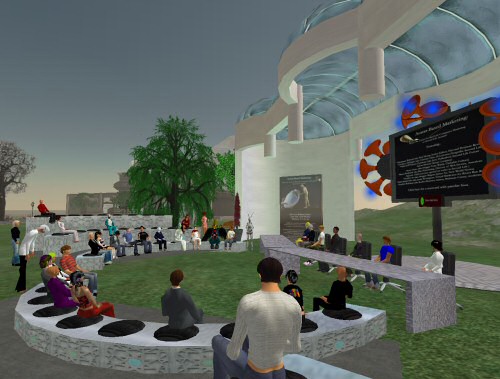
Neville reports on a panel session that was conducted in Second Life. The session drew marketing and new media professionals like Joseph Jaffe and Mitch Joel for a serious discussion of avatar-based marketing.

Meeting in Second Life

This is a picture of the meeting taking from Neville’s perspective. That’s him in the foreground.

According to Neville,

… this was something quite extraordinary. Here was a group of people getting together in a virtual world for a business meeting. You didn’t know who anyone really was, whether who they say they are is who they really are, where they’re from, and whether it really is a man or a woman you’re talking to.

But none of that matters. It’s part of the experience and interactions in a virtual world.

Neat. And for the folks at Thornley Fallis who are reading this, don’t be surprised if the next interoffice meeting you’re invited to requires only that you travel as far as your computer to sign into Second Life!

Are you a member of my community?

Who are you?My community is the people whose blogs I read and communicate with. My community is also the people who read my thoughts on this blog. Some enter into a conversation through comments and trackbacks. Some are silent.

The people who I read and link to may be much more important to me than I am to them.

It’s a bit like the false intimacy we all feel with Katie Couric or Peter Mansbridge. They sit across the room from us every evening and project their personalities onto the world around us. We feel like we know them. But they know us only as demographics and ratings.

Celebrities have known this false intimacy for years in the people who walk up to them, address them by their first name and start to ask questions about the personal details of their lives.

The blogosphere is a bit like that. In the PR world, I regularly read Hallett, Holtz, Hobson, Israel, Eggertson, Jones, Baradell, Basturea, Defren, McKay, Cody, Rubel, Clarke, Jenkins, Papacosta, Demopoulos, Sansone, and Fallis. I frequently comment or trackback to their sites. Of course, I am only one of dozens of people who do this. So, if I asked these folks if they think of me as part of their community, I wouldn’t kid myself about their answer. Some would respond with “Who’s Joe Thornley?” Others might go so far as to say, “I know him. He comments or leaves trackbacks to my site from time to time.” Does this make me part of their community? Maybe. But very much on the periphary. Is this bad? Not at all. Community is built over time.

The traffic numbers on my site tell me that there are many people who read my blog, but who have yet to comment on it or link to it. I’d like to know who you are.

So, a request. Please help me to know my community better. Leave a comment on this post to let me know who you are, what part of the world you hail from and what you do. (e.g. PR, advertising, student, etc.) And if you have your own blog, please write a brief post with a trackback to this article. I want to add you to my blogroll.

Then, check back to see who considers me part of their community.

PR community warms to social media, but unevenly

I’ve just attended three conferences in the past month – Mesh in Toronto, PRSA Counselors Academy in Savannah, and the IABC International Conference in Vancouver. I came away with a sense that the PR industry is warming to the importance and potential of social media to transform the practice of public relations.

Mesh Toronto 2006However, adoption is neither uniform nor universal. The conversations I participated in showed that the industry ranges widely in both awareness and understanding. The attendees at Mesh are technophiles who have embraced the full range of social media and are looking for the new cutting edge applications that will further empower online communities and collaboration.

Counselors Academy 2006The group that has farthest to travel were the participants in the PRSA Counselors Academy.

It’s noteworthy that Counselors Academy is composed primarily of principals and owners of mid-size firms. There could be several explanations for these people to be late to the party. Mid-size firms rest heavily on the key skills and vision of their founders, whose imaginations may not have embrace social media. Or perhaps it reflects the need for principals of small firms to be closer to day to day client work. They may not have the ability to gaze into the future in the way that large firms with their corporate leadership can.

Whatever the reason, the mid-size firms ignore social media at their peril. As was pointed out by Peppercom’s Steve Cody when he told people attending his workshop at Counselors Academy that

“Complacency is a killer. It’s critical to figure out how to differentiate yourself because the marketplace is rapidly changing.

“Agencies that just keep on doing what they’ve been doing for years are heading for trouble. The field of dreams approach does not work. We all have the same kind of relationships with journalists. … The more you are seen as just an order taker and a tactical media relations operation, the more your business will be marginalized.”

IABC International Conference 2006Much more encouraging however was the IABC International Conference in Vancouver. At last year’s conference in Washington, I can only recall there being one session focusing on blogs. This year there were half a dozen – and virtually every one was packed. The presenters were outstanding: Neville Hobson, Allan Jenkins, Shel Holtz (at three sessions), Tom Keefe, John Gerstner, Tudor Williams, and Tod Maffin.

It’s clear that the IABC conference participants, populated by communicators from larger organizations and business, are engaged in figuring out what social media means to and for their organizations.

Overall, I’m encouraged. And looking forward to next year’s conferences. Without doubt, the pace of adoption of social media will accelerate in the coming year and – based on the pattern of adoption that I witnessed this year – new stars are likely to emerge and other established players may suffer for their tardiness in joining the discussion.

What do you think? Am I seeing patterns that don’t exist? Do you have a different view of how the industry is embracing social media?