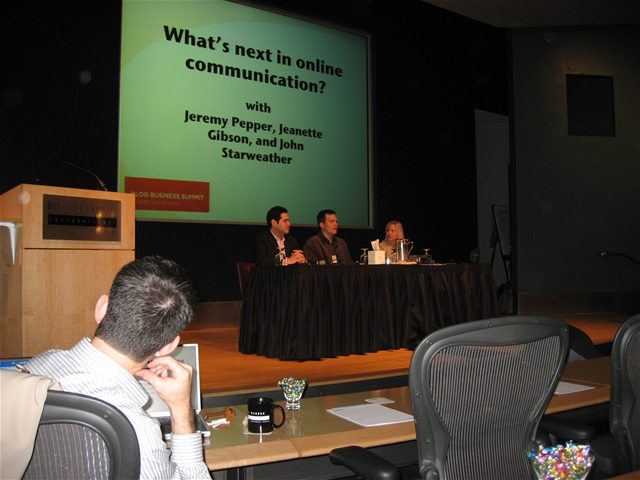
BBS: Jeremy Pepper, Jeanette Gibson and John Starkweather

Jeremy Pepper, Jeanette Gibson from Cisco and John Starweather from Microsoft kicked off the conference with a session titled What’s Next in Online Communications?

John Starweather led off by talking about Microsoft as a place to blog and a place to innovate. John is involved in the Mobius project which is developing new applications and platforms for mobile technologies. He believes that we will soon see even more useful applications for mobile devices.

Jeanette talked about Cisco’s efforts to use the new social media to develop feedback and communication with customers and users.

One of the audience members asked the panelists about their efforts to educate employees about the potential for engagement and how these tools can be used internally. John responded that he believes that most marketers have not yet grasped the full potential of social media and the changed relationships with consumers. As he talks to people internally, people are demanding data. And this is an area that must be focused upon. Good data to show what is really happening.

Jeanette says that Cisco’s CEO communicates with employees using Vlogs. They have an IPtv network internally. They’ve also developed an internal Wiki to share information.

A couple members of the audience raised questions about Second Life. One questioner asked Jeremy about his views on crayon’s Second Life presence. Jeremy suggested that Second Life provides the crayon partners with a presence in a single “place.” This overcomes the fact that they are geographically dispersed in four cities thousands of miles across. As such, it’s a clever move.

John suggested that the future will see mobile devices becoming as ubiquitous and non-intrusive as watches have become. Developers should watch this closely and be sure to design for the small screens of these devices.

How can social media be proved and sold internally? Jeanette suggested that she and her colleagues are spending a great deal of time trying to find indicators of effectiveness. For their web newsroom, they attempt to identify the social media opinion leaders and to demonstrate that these people will generate content that will lead mainstream media coverage.

There were no great new insights at this session. But is was a nice warm-up for the audience. And the best indicator for this was the buzz that began in the auditorium immediately after the session as members of the audience turned to one another and kept the conversation going.

Business Blog Summit – Thursday sessions

I’ve arrived in Seattle for the Blog Business Summit.

I’ll blog as much of the conference as possible. Sessions I’m hoping to take in today include:

And that’s just in the morning (whew.) In the afternoon, I’m looking forward to:

  • Mary Hodder, Dave Taylor and Halley Suitt, RSS and Feeds: Monitoring the Blogosphere and the Buzz
  • Ben Edwards, Nicki Dugan and Betsy Aoki: Corporate Blogging Policy
  • Betsy Aoki, Korby Parnell, Jeff Sandquist and Jana Carter: Microsoft and Social Media: Lessons Learned from MSDN Community Blogs and Channel 9

I’ll try to live blog each of these sessions (surely there will be Wi Fi). If I get a good connection, I’ll post after every session. Otherwise, they’ll come in a bunch whenever I can get a connection.

I hope you’ll follow along

Ottawa communicators meet to discuss social media

At lunch today, I participated in a panel discussion sponsored by CPRS Ottawa-Gatineau on the theme: Knowing What You Don’t Know: Are Blogs and Social Media Changing the Communications Landscape? My fellow panelists were blogger Ian Ketcheson  and Rob Henderson from CNW Group.

Rob Henderson said that while many of CNW’s clients have been slow to embrace social media, they now are are expressing increasing interest in it. They know something is coming. And they want to be ready for it when it breaks into the mainstream.

Publicly traded companies are concerned about what they don’t know. The unknown lends a random, unpredictable element to the management of their corporate reputation.

Rob suggested that a number of the larger companies are holding back on social media because they want to see some of the early adaopters make the mistakes. Then they will have the “before” picture and be able to engage in social media with a set of established best practices and known conventions.

CNW has been introducing multiple streams of multimedia to match their clients’ appetite as it develops.

Ian Ketcheson talked about the environment for social media in government. He believes that senior executives in government get the significance of social media. It’s seen as one of the most pressing issues that they must deal with. And they are struck by the speed with which the changes driven by social media are occurring.

The breaking of news about the Gomery Committe on the Captains Quarters blog brought home to government communicators that traditional means of controlling news and information have broken down. Garth Turner’s expulsion from the Conservative caucus demonstrated that a public figure can harness the blogosphere to match large organizations in advancing his or her position.

There is much experimentation with social media in various parts of the government. Like social media itself, it reflects the initiative of individuals operating beyond a centrally planned and controlled strategy.

The discussion with the audience touched on a broad range of issues, including the power of social media to conduct consultations with people regardless of their geographic location; the power of blogs behind the firewall to bring organizations together and to provide a channel for genuine and spontaneous feedback; and social media as a tool to enhance collaboration.

The point was also made that many blogging reporters are exploring potential stories first on their blogs. They may then assemble a perspective and body of facts necessary to compete for the limited space in the mainstream media outlet. Finally, communicators must prepare their organizations to surrender the fiction that they control the message and instead understand that the era of social media requires that communicators engage in persuasion, not control.

I ended the session with an invitation to the participants to visit this blog post and get engaged in social media by leaving a comment. So, the success of my contribution will be judged by whether there are any comments here.

Mathew Ingram and Jon Husband to speak at Third Monday and Third Tuesday

We have two great speakers at this month’s Third Monday and Third Tuesday social media meetups in Ottawa and Toronto.

Third MondayOn October 16, at Third Monday in Ottawa, Jon Husband will take us on an exploration of “the mashup culture of social media, and talk about how it is changing how messages are communicated. How do these innovations apply to the workplace? How are they changing collaboration? How do they change our relationship with the public and constituents?” Interesting questions.

Third TuesdayThe next night, October 17, Third Tuesday Toronto attendees will spend the evening in discussion with Globe and Mail technology writer Mathew Ingram. “A typical day for Mathew still includes researching and writing copy for tomorrow’s paper, but also populating the Globe’s “geekwatch” blog as well as his own, extremely popular, personal blog. With these added demands on his already limited time, how should PRs approach him? What stories are good blog fodder, and what will make it through to the dead tree version? Mathew IngramAnd why should you care where it goes? Mathew will also share his thoughts on why he started blogging, the difference between his personal blog and Geekwatch, the current crop of Web 2.0 technologies and his predictions on the evolution of social media.”

Sign up to attend Third Monday with Jon Husband or Third Tuesday with Mathew Ingram. I hope to see you there!

A case study of a viral post

HP’s Eric Kintz has posted a case study blogging viral marketing effects that is a must-read for anyone interested in understanding social media.

Eric based his case study on an earlier post regarding the importance of posting frequency. Eric’s post on his belief that blog posting frequency doesn’t matter anymore was referenced on other blogs close to 150 times (make this more than 150 times) and continues to be linked to more than four months later. (Darn, I’ve just done it again!)

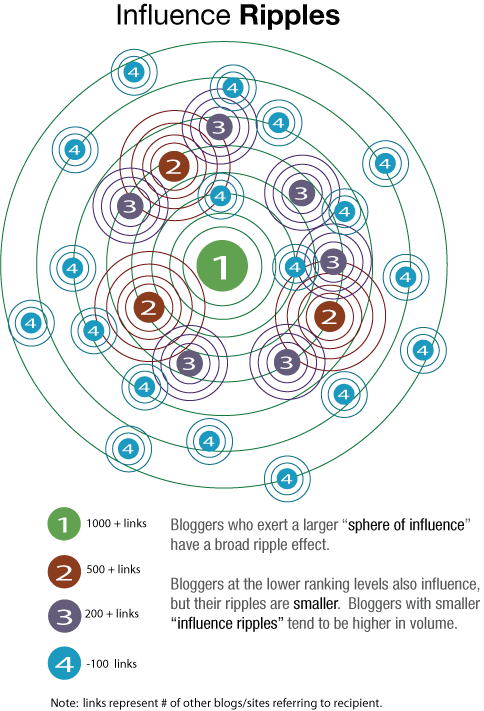
Eric points to other factors that contribute to viral success, including strong content that was relevant to the blogging community, early links from level one influencers, tie-ins to blogging micro-communities, pick-up by mainstream media and newsletters, and localization/translation into other languages.
Eric Kintz's Influence Ripples

In an earlier post on the dynamics of viral marketing, Eric stated that, “Viral marketing does not spread well. In epidemics, high connectors are very critical nodes of the network and allow the virus to spread. In recommendations networks, a few very large cascades exist but most recommendation chains terminate after just a few steps.”

He finds support for this in the case study of his own post. “In this specific case, the post did not get linked to by more than 3-4 blogs in specific communities. This reinforces the well known rule to reach early on level 1 influencers, i.e. bloggers with more than 1000 links according to my blogging friend David.”

But it’s not just all A listers/Level 1 bloggers. Kintz was surprised to see his post picked up in an unexpected place. “Connectors are absolutely essential to spreading word of mouth, but they should not necessarily be confused with so called “A-listers”. The rapid scaling of the blogosphere with a doubling in size every 6 months (see my post on this growth) has triggered the development of micro communities around very specialized topics. Word of mouth can spread by connecting to the connectors in those micro communities. My biggest surprise has been to see this post spread through word of mouth among Christian church bloggers and Washington political blogs.”

Eric’s post is well worth tagging and sharing.

Thanks to KD Paine for pointing to Eric’s post.

Shel came, Shel was seen, Shel conquered

Shel Israel, Author, Speaker, Nice Guy!Six events in three days. One very hoarse voice. One exceptionally generous man.

Shel Israel came to Canada this week. And we benefited from his insight, wisdom and advice regarding the potential of blogging and social media to bring about a major change in the way that organizations communicate both inside with employees and outside with the public.

During his time here, Shel met and spoke with over 100 Canadian communication and marketing decision-makers. And from the questions and the interested, engaged looks on people’s faces, I am sure that he had a significant impact. In the next six months, I believe that we will see more Canadian companies and organizations incorporate social media into their communications programs.

That will make us smarter, more effective communicators. That in turn will help Canadian companies to be more competitive and Canadian organizations to better serve their stakeholders.

And that’s exactly what we hoped that Shel’s trip to Canada would achieve.

Thank you Shel. You’ve made a difference. What better thing could be said about any of us?

The spirit of the blogosphere translates into real world meet ups

In the wake of the inaugural Third Monday with Shel Israel, Ryan Anderson reflects on how bloggers reach out to one another in the real world. And as we do, we apply the online blogging culture to those encounters. Ryan says,

I go to a lot of events where I don’t know anyone, but I’ve always found that events with bloggers who I’ve “met” through comments or just reading are always much easier. 

We are a group of like-minded individuals, who are accepting of each other by virtue of a membership to a group, which we earned through a ritual of writing and reflecting and of sharing our insights with other bloggers.  Our beliefs, independent as they may be, are largely influenced by a book that is at the core of the culture.  When we come together as a group, there is an automatic acceptance, because we know that bloggers are there not to self-promote, but to share.  Those that were there to promote, were kept outside the group because they were there for themselves, not for the greater good.

Bloggers allI think he’s right on here. I’ve been at bloggers events in the past week in Chicago, Ottawa and Toronto. And at each one, people approached one another with an openness and an eagerness to share stripped of all the usual trappings of competition. We’re happy to meet the people with whom we share so much online and we approach them as we find them – through their thoughts and words, not as competitors or rivals.

In fact, I was reminded of this at the Third Tuesday in Toronto. When Shel Israel referred positively to Sun CEO blogger Jonathan Schwartz, a voice was heard from the back of the room boasting loudly, “They’re our client.” YECCCHHHHH!

The boaster clearly didn’t get what the evening was about. It wasn’t about bragging about wins. Or who is winning at the competitive table. It was about exploring the frontier of social media together.

And the crowd demonstrated this with their response. They room responded with silence and by ignoring this outburst of braggadocio.

We were there for one another. Not to make points.

That’s just one of the many things I like about blogging and bloggers.

Toronto communication executives talk social media with Shel Israel

Shel Israel wrapped up his Canadian social media tour with a breakfast session with Toronto communication executives.

‘You gain credibility for your organization by being honest about your company even when it has made a mistake.”

“Dell computer has demonstrated that a company can learn. That a company which is under attack can enter into conversation with its critics. And if it listens and is willing to respond to the feedback it receives, it will find that those people who care, those people with passion, will become engaged with the company. And the company can develop a stronger bond with those who are most passionate.”

“The power of the blogosphere is that we’re all influential.”

 How about the lawyers? “Lawyers are paid to assess risk and warn clients that this could happen. A blogger could say something to embarrass the company, reveal IP, reveal trade secrets. Yes, this might happen. But to date, with over 55 million blogs existing, there has been no lawsuit relating to leakage of IP. There has been no groundswell of consumers in arms because of something they learned about a company on an employee blog. This may happen. But it hasn’t happened yet. So, the response to the lawyers is found in a realistic assessment of the real risk.”

How does a company get above the noise level? “Write something relevant to me. You don’t need to reach everyone. You need to reach the people who care about you. So write something useful and of interest to them.”

“And understand that blogging requires patience. You must  listen over time. Understand the community. Then you must develop your own voice by posting, listening to feedback, learning and adjusting. But if you are prepared to do this over time, you will succeed.”

“One of the great benefits to a company when it allows employees to blog is that it is sending a signal that ‘We trust you.'”

Toronto social media community gathers at inaugural Third Tuesday

Over 50 Toronto area social media types gathered at The Pour House for the first Third Tuesday meetup. The room was full of bloggers and podcasters, including: Ed Lee, Michael Seaton, Chris Clarke, Josceln Smith, Mary Ellen Armstrong, Donna Papacosta, Lisa Walker, Douglas WalkerTamera Kremer, David Jones, Julie Rusciolelli, Michael O’Connor Clarke, Jeremy Wright, Leona Hobbs and Terry Fallis.

The attendees were treated to a great interactive session with Shel Israel and Canadian blogger/business journalist, Mark Evans.

Mark kicked off the session by telling the story about Shel’s previous trip to Toronto. Apparently Shel didn’t bring his passport on the trip. A problem when he reached Canadian Immigration. Undeterred, Shel produced a copy of Naked Conversations and pointed to his picture on the cover and said, “See, this is me.” Happily, the Canadina immigration officer conformed to the polite and obliging Canadian stereotype and admitted Shel on the basis of his book cover credentials!

Shel brought his passport on this trip.

Then Mark and Shel kicked into a full Monty Naked Conversation.

Mark: “So what about the next book, Global Neighbourhoods?”

Shel: “As I was sitting in Silicon Valley, which had once been seen as the centre of everything, doing interviews for Naked Conversations, I realized that a lot of what was most important was occurring on the edges. No longer was it necessary to move to Silicon Valley to be close to the action.”

Shel Israel, Terry Fallis, Donna Papacosta, Tamera Kremer Mark: “How about virtual worlds? Where does that fit into your vision of social networking?”

Shel: “There’s a line from Virginia Woolf about Truth or Illusion – how do you tell the difference? Many people are fascinated by Second World. Some people express themselves better in this kind of environment. And people should do what they feel comfortable doing.”

Mark: “I took three weeks off work this summer and read your book. 😉  I look around me in Canada and I don’t see much corporate blogging. Is it happening in the way you expected?”

Shel: “No, the adoption is going more slowly than we thought it would. But it is accelerating. Since January of this year, it’s gone from three of the Fortune 500 companies to about 30. Corporations are doing what they do. They are being cautious and risk avoidant. They are meeting and talking about whether they should be doing it. And then they are dipping their toes into the water. Then their ankles.”

“For years, corporations have been going the other way. It takes them time to reverse course. And that’s what many of them need to do. I worked with Wells Fargo. At first, they sucked. But they got better. It took them three months. But they improved.”

Dave Forde: “Now that Robert Scoble has left Microsoft, has the tone of his blog changed?”

Shel: “Robert’s a lot happier since he left Microsoft. He’s now doing what he loves. And the passion is coming out in his blog.”

Mark: “When Scoble left Microsoft, I thought his profile might decline.”

Shel: “That didn’t happen. And the other thing that didn’t happen is that Microsoft didn’t go back to being the Borg.”

Audience Question: “Whose blogs tend to be shining examples of good corporate blogs?”

Shel: “What is really wonderful about the blogosphere is that you can go out and find the blogs that YOU like. For me, the number one issue for most corporate blogs is that they are boring as hell. If you learn anything, listen closely, because the people who talk back to you are the people who can really teach you something.”

Michael O’Connor Clarke: “Is there such a thing as a corporate blog? Companies don’t blog. People blog. “

Shel: “Microsoft broke ground by hiring Scoble knowing that he would blog when he got there. Robert was hired by people who knew that he would shake things up, that he would speak out. Maybe they didn’t know that he would speak out against Ballmer’s position on gay rights. But they didn’t do anything to him when he did speak out.”

Audience question: “How about companies that start to blog when they are in crisis cycle, such as Dell and Ford?”

Shel: “While Dell started out poorly and made some mistakes. But since they launched the blog, they’ve committed an extra $100 million to improve customer service. They handled the battery situation well. Unlike Sony, who have been quiet about the fact that it was their batteries. And who have yet to engage with consumers on the problems with their product.”

“Looking at Ford, they are a company that has done a lot of
things wrong for a long time. And a hundred blogs won’t help them.”

Mark: What’s your take on podcasts and video casts?”

Shel: “When we wrote Naked Conversations a year ago, podcasting was very small. Social media is now getting bigger than blogging itself. Some people are comfortable with text. Many corporations are more comfortable with audio and video because they have a greater sense of control. That’s great, because this will soon become much more interactive.”

Audience question: “One of the things that companies are spending money on is monitoring the conversation and identifying influencers. What do you think makes one person more influential?”

 Shel: “Four years ago, a blogger named E.A. Spouse posted about her husband’s working conditions at Electronic Arts. One of the readers was Scoble. He picked it up. It was amplified quickly and appeared in mainstream media.

“At the time of the London subway bombing, the BBC learned of the bombing from a person who captured images on his cell phone.

“Metcalfe’s law states that the network becomes more powerful the greater the number of nodes in the network. In blogging, we are the nodes.

“So, anyone who is blogging can become very influential.”

“The tipping point has been reached. Blogging is.”

Much conversing. Much networking. A GREAT way to launch Third Tuesday.