Let's talk about starting Third Tuesday in Vancouver

For the past year, Third Tuesday/Third Monday have provided the social media community in Toronto and Ottawa with a monthly opportunity to gather, hear from great speakers and talk about new developments in social media and social software.

Third Tuesday VancouverAs we look forward to this autumn’s season, we’re hoping to start up a Third Tuesday in Vancouver. Vancouver has a great community of social media thought leaders and innovators. So, it’s a natural for us to try to extend the events to Vancouver.

Several people, including Tod Maffin, Kate Trgovac, Tanya Davis, and Darren Barefoot (when he returns from his global jaunt) have said that they are willing to pitch in to make this happen.

I’ll be in Vancouver next week on my way to Gnomedex. So, we’re organizing a get-together to kick off the planning for the fall season. If you’d be willing to help with the organization of Third Tuesday Vancouver, we’d love to have you join us. Just leave a comment on this post or send an email to me and I’ll send you the coordinates of our get together as soon as we’ve finalized it.

We’d also welcome your suggestions for topics and speakers. Please feel free to leave a comment or send an email with your ideas about what we should cover and who might speak to it.

Google Finance in Canada – A question of timing

The Official Google Blog announced tonight that Google Finance Canada will offer “a localized version of Google Finance tailored specifically, as you might guess, for Canadian investors.

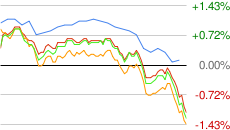
And what’s the first thing that grabs your attention at the top right corner of the page? This graph, showing the index trends for the July 31 trading day.
A question of timing
Yep. A good day to for an announcement. That kind of trend should draw people like moths. It’s a bit like having a water depth gauge on the deck of the Titanic. You just can’t look away.

Answering Shel Israel about Social Media in Canada

Shel Israel asked me for my views on differences and similarities in the development of social media in Canada.

Our economies and communication networks are so intertwined that it would be noteworthy if there were any significant differences in the pace of technological adoption and innovation.

However, I think the truly significant difference relates to social media’s potential to transcend the impediments to self expression that Canadians endured as a result of limited bandwidth, high production costs and the complex distribution systems of traditional cultural industries.

I’m late in responding to Shel. So, rather than publish a lengthy written post, I’ve tried to capture my thoughts in a video. I hope that you’ll take a look at it and share your perspective on this by leaving a comment.

[MEDIA=3]

I just noticed on second viewing that I inadvertently made my point about the dominance of U.S. cultural product in Canada. If you look closely, you’ll see that the two authors whose books flank me on either side are Stephen King and David Halberstam. Next time, I should sit in front of Margaret Atwood and Robertson Davies!

Shel Israel asks about social media in Canada

Shel IsraelRecently, Shel Israel, co-author of Naked Conversations, was commissioned by SAP to conduct a study of the state of social media around the world. Shel explains it this way:

Here’s what I am doing. I am trying to answer a single, overwhelming question: “What is going on in the world with regard to social media? I am looking for useful statistics, but those are often outdated before they are published as we learned with the book.

Mostly I am looking for real people with stories and personal experience about what is happening with blogging, video, online communities and assorted conversational media. I’d like to get some anecdotal granularity on why blogging is taking off in Poland these days, or how social media behavior is different in Italy than it is in Russia and Canada.

Shel sent me his questionnaire just before I left for vacation. It was a good vacation and I didn’t do much of anything, including Shel’s questionnaire. So, now I’m about to start. And I’d like the social media community in Canada to have a go at the answers with me.

Here are the questions that Shel put to me.

  1. You are very much in touch with social media in the US and Canada. How would you describe the similarities and differences of the social media evolution in the two countries?
  2. The journalist Mark Evans has written often about how slow Canada’s business has been to adopt to blogging and social media. Do you agree with him? If you do, why do you think this is and do you think it is a trend that will continue?
  3. Which social media tools are the most popular in general in Canada? What about among business users?
  4. Canada is a bilingual country. How has this impacted social networks and blog audiences? Do you think social media can play a role in bringing French and English speaking people closer together in Canada?
  5. Is social media in Canada just for young people or is it spreading across multiple age barriers? What do they talk most about? How much of the conversation is business oriented?
  6. Who or what are the greatest influencers on social media in Canada?
  7. You and I have talked about Canadian businesses wanting greater access to American markets. How does social media lay into that strategy?
  8. Can you give me one or two brief case studies of social media in Canada impacting business?
  9. What trends do you see in Canada these days?
  10. Additional comments

In the next few days, I’ll post about each of Shel’s questions. As I do, I’d welcome your thoughts on both the questions and my answers.

Please post any comments you’d like to offer and I’ll incorporate them in my responses.

The Spirit of Generosity

A while back Shel Israel wrote a post which touched upon the impact of the “cult of generosity” on marketing.

Tara HuntToday, Tara Hunt has a great post about the real meaning of the spirit of generosity and the gift economy. This is a must-read post for anyone who really wants to understand what motivates many of the social media thought leaders.

Thank you Tara for reminding us about what this should all be about.

Sean Moffitt Wants You for Canada's 1% Army

1% ArmyThe hyperkinetic, ultra-connected Sean Moffitt is looking for bloggers who would like to enter their blogs into a “tournament” of Canadian bloggers.

If you write a blog that deals with digital, tech, online, media, social media, PR, marketing, communications, design, or research, you can enter your blog in the Facebook group that Sean has set up or via the Contact Us link on Buzz Canuck.

1 percent armyBlogs will be matched in pairs for each round, with only the winner of each pair advancing to the next round. The judges will judge two posts submitted by each blogger on five criteria: “overall impact (20%), clarity of thought (20%), did it make me want to think/act differently (20%), did it want me to comment/participate (20%) and originality (20%).”

Sean is aiming for a starting field of 128 blogs. Already, he is half way to that goal. The initial list of entrants reads like a Who’s Who of the Canadian social media scene, including Kate Trgovac, Doug Walker, Bill Sweetman, David Crow, Michelle Sullivan, Marc Snyder, Michel Leblanc, Mitch Joel, David Peralty, Ed Lee, Colin McKay, Collin Douma, Jonathan Dunn, Brendan Hodgson, Leesa Barnes, Dino Demopoulos, Michael Seaton and Eden Spodek.

Sound like a good way to get your blogging juices flowing? For sure.

So, hop over to Buzz Canuck and tell Sean that you want to be entered into Canada’s 1% Army tournament.

Managing Your Social Media

We are becoming overloaded with a surfeit of social media sites and tools. We can either break under the load of options or we can find ways to cope, to manage our social media.

Bryan Person came all the way from Boston (6 hour drive) to talk to Podcasters Across Borders about how he manages these tools – and we’re glad he did.

Bryan Person-1 First, you have to make hard decisions. Make choices among the essential tools.

Develop a routine to allow you to cover things quickly. For example: Email; Twitter; Facebook; Calendar; Blog Reader. Then you’re good to go.

Using Tagging to save items associated with terms that are meaningful to you.

Prune your feedreader subscriptions. In fact, think of deleting all of them. You’ll quickly re-subscribe to those feeds that really matter to you.

Trust your network for recommendations. You don’t need to subscribe to or read everything. If one of your friends spot something that he or she thinks is important, they’ll pass it along to you.

Finally, be prepared to step away. Turn your computer off. Enjoy life. Then you can come back to the computer refreshed.

Creative Commons Licensing in Canada

Andy Kaplan-Myrth and Kathi Simmons from the University of Ottawa’s Law and Technology Program spoke at Podcasters Across Borders about the legal regime that podcasters and bloggers in Canada must observe.

Kaplan-Myrth outlined the fundamentals of Creative Commons licensing in Canada.

Traditional copyright seeks to reserve all rights to the author other than those that she specifically surrenders.

Creative commons has been developed to encourage sharing of information. It has several different licences that allow sharing based on a selection of different elements:

  • Attribution: Content may be used and redistributed, but the original creator must be given credit for it.
  • NonCommercial: The content may be used and redistributed only for noncommercial purposes.
  • NoDerivatives: People can use and redistribute, but not modify the work.
  • ShareAlike: Users can use, redistribute and modify your work. But if you do modify it, any work that you produce based on these changes must have the same ShareAlike condition.

In Canada, there are over 300,000 works licensed under the Canadian Creative Commons. This Canadian licences have been customized to reflect Canadian laws, so Canadian bloggers and podcasters who use a non-Canadian CC licence should switch to a Canadian licence.

Kathi Simmons unveiled the Canadian Podcasting Legal Guide. It has been prepared by the Law and Technology group at UOttawa to provide Canadians with the basic information they need to understand the law that applies to authoring and using content for social media in Canada. 

Hard copies of the guide were distributed to PAB attendees.

The Canadian Podcasting Legal Guide will be available for download form the Canadian Creative Commons site.

Technorati Tags:

Podcasters Across Borders

Podcasters Across Borders brought together about 125 podcasting enthusiasts for two days to talk about everything podcasting.

Some fresh voices that I’m not used to hearing at the standard conferences I attend.

Ted Riecken delved into podcasting as a community.

Communities exist as an expression of shared interests, similar backgrounds, shared needs. Podcasting exists as a liberatory space – a place where many people on the periphery can share in the common wealth of knowledge. As a communication medium, it serves as a gathering place.

Podcasting provides a means for people to tell genuine stories to a community with common interests in a largely unregulated environment.

Podcasting has many of the characteristics of a frontier culture. It is transitory, emergent and constantly evolving. Like a frontier economy, there are still limited and alternative forms of commerce. The discussion of “how do I monetize my podcast?’ does not yet have a universally accepted answer.

The podcast culture places an emphasis on freedom, opportunity and growth. Much of the content originates on the edge and reflects niche interests.

Podcasters place an emphasis on freedom of speech, thought and expression. They prize real people telling authentic stories about lived experience.

The echo chamber effect presents a challenge to the evolution of the podcasting culture. To overcome this, it is important to emphasize diversity, critical inquiry and thought, to offset the positive feedback loops.

Technorati Tags:

Smart posts by smart people about Enterprise 2.0

Enterprise 2.0

The final day of Enterprise 2.0 was a bit of a bust for me. I just didn’t connect with the speakers in two of the three panels I attended. And the scheduled speaker for the third session was a no-show!

But the good news is that the conference was heavily blogged and many of the other posters found a good deal of value in the sessions they attended. So, for my final post about the Enterprise 2.0 conference, here are some posts that I think are worth reading:

And for something extra, read these posts:

  • Jeffrey Walker reports on one of those dinner discussions that make attending an event really worthwhile, this one on the ROI of Enterprise 2.0.
  • Alec Saunders offers reflects on what’s really going on with Enterprise 2.0. And he thinks it’s something big.

So, that’s it for me here in Boston. Air Canada’s calling my flight and I’m heading home to Ottawa.