If you are in Toronto today … read this

Shel HoltzThird Tuesday with Yahoo! Canada’s Hunter Madsen is being held this evening.

And here’s a neat extra treat: blogger and podcaster Shel Holtz is in Toronto today and he will be attending Third Tuesday.

So, if you’ve ever wanted to meet Shel, hop over to the Third Tuesday Social Media Meetup site and register to attend (it’s free.)

Third TuesdayHunter Madsen. Shel Holtz. Meeting with Toronto’s social media community. What better way could there be to spend a Tuesday evening?

Yahoo's Hunter Madsen will speak at Third Tuesday

Hunter MadsenYahoo!‘s services are close to the heart of every blogger. Flickr, del.icio.us, Upcoming. They provide us with means of finding, publishing and sharing information as we connect to and build our online communities.

And we wonder about their future. What plan does Yahoo! have for their social media services? Will they improve and offer new features that we can use to better connect with our communities? And for some of us, how can Yahoo! help us to generate revenue from our blogging efforts?

On April 24th., we’ll have a chance at Third Tuesday to talk about these and other issues with Hunter Madsen, Yahoo! Canada’s Head of Marketing.

Third TuesdayThis promises to be a good event. So, if you want the latest scoop on what’s happening at Yahoo! and their plans for social media, jump over to the Third Tuesday Meetup site and register to attend the event with Hunter Madsen.

Do you know your citizen marketers?

Blogger and author Jackie Huba was the keynote speaker at the CMA Word of Mouth Marketing Conference in Toronto this morning.

According to Huba, we live in an “amateur culture” in which consumers can, for little or no cost, produce content that shapes our brand image. These amateurs are pre-empting the traditional business model. Huba and her co-author, Ben McConnell, call these people Citizen Marketers.

This amateur culture has been empowered by ubiquitous technology like camera phones married with social media. Everyone can be a broadcaster. Anyone with a microphone and computer can produce and post their own podcasts. Anyone can upload pictures to flickr and video to Youtube.

And as people produce more and more of this content, it has gained influence.

Huba and McConnell have classified citizen marketers into the “4Fs”:

Firecrackers: People like George Masters and Brian Finkelstein. They create an explosive impact, a great deal of noise. They can have tremendous impact on brands – either positive in the case of Masters and the iPod or negative in the case of Finkelstein and Comcast.

Filters: These people are brand journalists. They have an overriding passon for a brand and they follow it incessantly. Mike Kaltschnee demonstrated the lasting impact on the Netflix brand that a group like this can have. Companies concerned about their brands should pay attention to and work with this group.

Fanatics: These people take the Filters one step further in their zeal for something. For example, Eric Karkovack had a passion for Surge. When Coca Cola eliminated the brand, he campaigned through savesurge.org for the return of the drink. He didn’t succeed. But when Coke began to test a new drink, Vault, Karkovack and others noted that its taste was very similar to Surge’s. He launched vaultkicks.org, a fan site for the new drink. Coke cooperated with him. And vaultkicks.org is the first Google search result for Surge soda. The fanatic has taken control of the brand online.

Facilitators: This is the most complex group in what they do. Paul Mullett with his mini2.com site is a good example of this type of person. BMW gave Mullett an advance peek at the second generation new mini prior to its launch in mid 2006. Mullett subseqently published photos, reviews and information about the second generation mini. And he reached a targeted audience interested in the mini with his message. On his own. At no cost to BMW. A marketers dream!

So, how are marketers starting to embrace these citizen marketers?

By working with these marketers to co-create content around a product or brand. For example, the Shakira fan video contest in cooperation between Youtube and Shaikira’s label helped reinvigorate the marketing around Shakira’s new album, which had until that point, failed to meet sales expectations.

By building community. Discovery, through its Discover Education subdivision and its United Streaming product, helps teachers to obtain valuable teaching content. Discovery created the Discovery Education Network to provide a focal point for teacher evangelists who wanted to use the product.

By Participation – The fifth P: Social media allows marketers to connect directly with customers.

The big question that all marketers should be asking themselves is how they can bring customers into their creative and brand process. If they can find ways to do this, they will inspire greater identification and loyalty for products. And that’s worth working for.

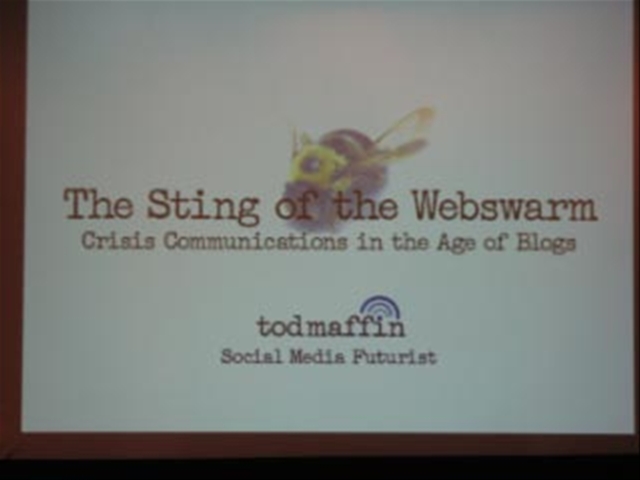
Tod Maffin and the Sting of the Webswarm

Blogging broadcaster Tod Maffin talked to a group of about 100 IABC Toronto members about the power of social media to shape and break reputations.

Webswarming is when masses of people congregate in the same place on the Internet. Swarms are led from the inside – like a swarm of bees. Corporate communications is very often out of sync with this way of thinking. Instead corporate communicators more often try to direct from the front, hoping that people will fall into formation behind them. With social media, we can position ourselves inside swarms to take advantage of many-to-many communications.

When a critical Webswarm forms around your company, you can respond with a simple five step S-W-A-R-M strategy:

  1. Sweeten the honeypot. Match your tone to the swarm. Be self-deprecating. Use humour. Be humble.
  2. Win-win.  Let them feel like they’ve “won”in some way.
  3. Advise them how you’ve changed. And do it within the first few sentences.
  4. Right wrongs: Correct inaccuracies. Don’t let errors stand in Google’s cache forever.
  5. Make friends. Email specific compatants and invite them to continue to provide suggestions, perhaps through an advisory panel.

If you want to be effective in the swarm, you must have an active and respected member within the swarm if you expect to communicate within it and learn from it.

Above all, put a human face on your postings and comments. Step out from behind corporate speak and be genuine.

Michael Geist on the power of blogging and issues that should concern every netizen

Dr. Michael Geist, blogger, columnist and Canada Research Chair of Internet and E-Commerce Law at the University of Ottawa was the featured speaker at this month’s Third Monday social media meetup.

Michael led off his presentation by remarking that blogging had taken on increasing importance for him in the past two years: If you’d asked me this time last year, I wouldn’t have known which I’d give up – the blog or my print column. This year, I know what I’d keep. I’d keep the blog. Because of the people who read it and the interaction I can have with them.

Blogging has enabled Michael to engage a broader community in discussions of significant issues, including Access Copyright’s Captain Copyright and erstwhile Canadian Heritage Parliamentary Secretary Sam Bulte’s relationship with the traditional copyright lobby. Time after time, he has found that people would become engaged in the issues he addressed and respond to his positions. And in doing so, they would advance not only his thinking but also have potential for broader impact.

 Project Cleanfeed is a good example of the potential for blogging discussions to flow over into real world impacts. Project Cleanfeed is an initiative to block access to child pornography. The idea is that the group alerts ISPs to the existence of child pornography images so that the ISPs can block access to them. Michael wrote a post that supported this initiative. This prompted about 60 comments in a few days. Not all agreed with his position. Many offered suggestions for change. Soon after his post, Michael received a call from the Director of Project Cleanfeed. And he was able to make several suggestions that flowed directly from the suggestions that came in on his blog.

This ability to have impact makes blogging highly attractive to anyone who has something to say.

So, what are the big issues that Michael is concerned about these days.

Connectivity: We need a strategy to ensure access to broadband for more Canadians. Michael noted that even a best case scenario will leave 5% of Canadians without access to broadband. At one time Canada stood at #2 in the world in access to broadband. Unfortunately, Canada’s access ranking is “sinking like a stone” and we are now around # 13.

Net Neutrality: This is fundamentally important. And it’s not just a U.S. phenomenon. It affects Canadians. The worst case scenario will come if parties like Google and Amazon decide to pay ISPs for top level service. They can afford it. The ordinary citizen can’t . And to be on the slow lane will hold back the access of those who cannot afford to pay. That will degrade the potential that many of us see in the new media. Canadians should press the government to address net neutraility at the same time it moves forward with telecom deregulation. And it’s the online community that has the opportunity and means to raise this issue.

Sidenote: Amber Mac and some of her friends started Canadians for Net Neutrality group in Facebook. When I looked today, 499 people had joined. 

Intermediaries: Michael recently received a legal notice relating to a comment on his site. This points to the legal protections and obligations of bloggers who allow others to comment on their blogs. In the U.S., parties that host content that is essentially not their own, are free of personal liability. In Canada, our situation is much different. The lack of clear protections creates an incentive for bloggers to delete contentious content. If we are concerned about people coming together to speak out on issues, then our legislators must advance legislation that will provide protection for people who speak out.

Copyright: Digital Rights Management (DRM) is a foundation issue. Think what will happen in a world in which we have all-digital TV that can be “locked down.” We are literally locked out of replicating the digital content for the purpose of ongoing conversation and comment. These discussions have implications beyond whatever you think about peer to peer file sharing. The U.S. already has legislation that tilts in favour of locking down content. Canada is being pressured to fall in line with this regime. Canadians should resist this pressure.

Fair dealing: The Canadian approach to fair dealing differs from that in the U.S. The current 1984/Hillary Clinton mash up would not be legal in Canada. This is another area of policy and law that requires review and updating.

One aspect of fair dealing is the right to share and distribute content that has been created by our government. The U.S. Congress has begun to distribute some content under Creative Commons licence. In Canada, the rights of sharing and republishing Crown Content – that is content that has been created by the government – are not as clear.  Under current Canadian law, the Speaker of the House of Commons seems to be able to determine use on an individual basis. From the perspective of fair dealing, why should we have to ask for permission on a case by case basis to use content generated by our own government? The issue of Crown Copyright is an important issue that should be dealt with to give Canadians free access to the government-generated content that they themselves have paid for.

All in all, an interesting presentation by Canada’s leading expert in e-law. Thanks to Michael for spending an evening with the Third Monday social media meetup group.

Blogging for dollars

Stuart MacDonald chaired a panel tackling the issue of monetizing blogs and podcasts. The panelists were Ryanne Hodson, co-author of The Secrets of Videoblogging, Michael O’Connor Clarke, Vice President of Thornley Fallis, Mark Evans, Vice President Operations of b5media, and Shel Israel, co-author of Naked Conversations.

What is the motivation for bloggers? Is it dollars?

Mark Evans argued that the first requirment for bloggers is passion. Shel Israel added that the best blogs are started by someone who has something they really want to say. However, once a blogger starts a blogger they will inevitably come to the realization that they are putting tremendous effort into and ask what they are doing it for. Michael O’Connor Clarke pointed out that there is a distinction between making money from blogging and making money because of blogging. Google doesn’t actually make money from search. They make money because they are a great search company. And the same thing applies to blogging.

 Ryanne Hodson agreed that blogging can help achieve other objectives. She hasn’t made a great deal of money directly from her vlog. But she has received job offers because she is a vlogger.

Mark Evans suggested that he is finding that established bloggers now are talking more about receiving a fair return from their blogging.

Shel Israel pointed out that the people who produce content have historically been the most poorly compensated relative to aggregators, distributors and exhibitors.

Ryanne Hodson indicated that many creators are seeking aggregator sites like blip.tv that provide a return to creators and show respect for creators’ rights over their content.

 Mark Evans said that b5media is trying to follow this course by defining a compensation plan for b5 bloggers that give them a share of the success along with a minimum monthly payment.

What about Lonelygirl15 or Bridezilla? These are examples of advertising thinking trying to find ways to fit social media into traditional marketing think. Stuart MacDonald suggested that the concern with them seemed to be more about driving traffic than building community.

Ryanne Hodson argued that its a fine line. You can do multiple things. Ryanne is making a living from video blogging.

Stuart suggested that the best monetization model may not be to derive revenue directly from blogging, but to instead look to monetize the activites as they support other enterprises. A means to a job (Ryanne Hodson). A means to position a corporation (Microsoft and Scoble). 

Michael O’Connor Clarke suggested that Bridezilla and Lonelygirl are examples of where things are going wrong – the attempt to create something artificial in a medium that is all about genuine, open and transparent communications.

Mark Evans said that b5media is trying to do online what trditional media companies have done online. To be a one stop shop for advertisers.

How about corporate blogs? Shel Israel pointed out that companies don’t blog, people do. And one of the problems with corporate and CEO blogs very often is that the people are afraid to expose themselves in an open and honest fashion. So their blogs end up being boring and not widely read.

The New World Order

The ICE07 conference followed Robert J. Sawyer’s keynote with a cross-platform panel. A few points that struck me as interesting:

Maria HaleMaria Hale, CHUM’s Vice President of Content Business Development, indicated that CHUM is managing Much Music as a multi-platform brand.

Brian Seth HurstBrian Seth Hurst uses CHUM as an example of a big media company that is accompanying its audiences on their exploration of the new media. CHUM is smart in the way it creates a bond with its audience and looks over their shoulders to see what they like and what they are moving toward.

Shel IsraelBlogger and author Shel Israel suggested that the next generation of consumers will be teflon resistant to marketing. They will be comfortable with the decentralization of content production. He argued that platforms like Joost won’t replace television. He likened it to rock and roll. “Rock and Roll didn’t replace Opera. But is sure did change the world of music.” Joost and platforms like it will have an equally profound impact on traditional television.

Brian Seth Hurst suggested that future business opportunities can be found in: profiling, aggregating, and automating. Profiling: As the consumer is able to express her preferences, understanding these preferences and the clusters of users will be essential. Aggregating: the distribution model of the future. Automation: Don’t make me look for content manually. Know my profile, find the content and deliver it to me automatically.

Mike Lee, Chief Strategy Officer of Rogers Communications Inc. suggested that Canada’s broadcast and distribution regulatory regime holds back companies from innovating as rapidly as they’d like. Changes in regulations are necessary to enable Canadian companies to thrive in the new era.

Broadband and the end of the dinosaurs…

The explosion in broadband capacity is having a transformative impact on our world of content and connection similar to the asteroid that wiped out the dinosaurs millions of years ago.
Hugo Award winning author and futurist Robert J. Sawyer offered this metaphor in his opening keynote speech at the ice07 conference in Toronto.

Sawyer told the audience, composed primarily of broadcasters and program producers that they can expect that change will only accelerate. The world has changed dramatically in the past 25 years. But as great as that change feels, we will experience a similar magnitude of change in the next 10 years. And change equal to that in the subsequent five years. And the next 2.5 years…

The future is 3D. The future is virtual reality. The future will eliminate the distinction between our online life and our real world life. The distinction in resolution of the online world will reach parity with the real world. And as it does, we will not distinguish between the two.

We will see the end of downloads. All content will stream. Storage will become virtually limitless.

Robert J. Sawyer

We will see an enormous uplifting in the quality of the content produced by prosumers. They will take advantage of higher resolution, unlimited bandwidth and storage along with the tools that exist today to produce content that equals that which is currently produced by the studios and big networks.

We’re moving away from the big studio. We’re moving away from the big company. Companies will only be able to cope with the pace of change by breaking down the vertical silos.

As corporate producers find themselves competing with prosumer content that is virtually free, they will face the challenge of finding a way to monetize their own content.

Branding will be important in any attempt to do this. Content producers must raise awareness of their personal brand in a world in which the branding of aggregators like YouTube has been superimposed on the creators’ brand.

Traditional media companies will only be able to survive if they go beyond copying prosumer trends to imagine the next innovations, the next trends and move to try them before the prosumers do.

Independent and prosumer content producers will be in a struggle with large traditional companies. In an era in which the traditional economics have scarcity have been superseded by the economics of digital abundance, the large companies have lost their advantage over the independents and prosumers.

As both large and small producers struggle to succeed in this new world, the winners will be those who connect more. New connections will yield new ideas and new patterns. Traditional media must recognize this and accelerate their contact with the new prosumer and independent producers.

These will be the new corporate and production organisms that emerge in the new world much as man emerged after asteroid wiped out the dinosaurs. The dawn of a new era.

I'll be covering the ICE07 conference today and tomorrow

ICE07I’ll be attending the ICE07 conference in Toronto for the next two days.

The conference draws an audience composed primarily of broadcasters and program producers. This year, there’s a social media thread in the program. It will be interesting to see how traditional media integrates this thinking into their discussions.
I hope to post on several sessions. So, stay tuned to this channel… feed.

Don't miss Michael Geist at Third Monday

Do you own an MP3 player? Download music or video? Are you interested in the future of copyright? Digital Rights Management (DRM)? Privacy on the Web? Are you concerned about maintaining free and open access to the Internet for all users – individuals as well as large businesses?

Michael GeistIf you answered yes to any of these questions, then you won’t want to miss the next Third Monday social media meetup. Because we’ve got Michael Geist as our guest speaker.

Dr. Geist is the Canada Research Chair of Internet and E-commerce Law at the University of Ottawa. He is a prolific and thought provoking blogger and a columnist on technology law issues in the Toronto Star, Ottawa Citizen, and BBC. He is a must-read for opinion leaders, policy makers and others interested in evolving our copyright and legal regimes to promote innovation in the use of the Web.

Third MondayIn the past year, Michael was a keynote speakers at the first mesh conference in Toronto as well as delivering the Hart House Lecture.

We’re very lucky to be able to have Michael speak to Third Monday.

So, if you’re interested in an evening of great conversation with an outstanding, thought provoking speaker, register online to attend Third Monday on March 26 with Michael Geist.